Best ERP Systems For Startups In 2026 (Complete Founder Guide)
Running a startup in 2026 is exciting, but it is also demanding. You are managing cash flow, tracking inventory, handling customers, and supporting a growing team all at once. If you are still relying on spreadsheets or disconnected tools, you have likely felt the frustration. Manual data entry wastes time. Errors creep in. Visibility across the business becomes limited.
That is where the right ERP system can make a real difference. Modern Enterprise Resource Planning platforms go far beyond accounting. They bring finance, HR, CRM, operations, supply chain, and analytics into one connected system. For startups and small businesses, this means better control, fewer mistakes, and smarter decisions backed by real-time data.
In this guide, we explore the best ERP systems for startups in 2026, highlighting key features, ideal use cases, and how to choose a solution that supports your growth without overwhelming your budget.

What is an ERP System?
ERP stands for Enterprise Resource Planning. In simple terms, an ERP system is software that helps a business manage its core operations in one connected place.
Instead of running separate tools for accounting, sales, inventory, HR, and projects, an ERP brings everything together on a single platform. All departments work from the same shared database, which means information is updated in real time and visible across the organization. This reduces duplicate data entry, minimizes errors, and eliminates the confusion that comes from disconnected systems.
A helpful way to think about ERP is to imagine a business as a living system. Sales, finance, operations, and supply chain may function independently, but they are closely connected. When one area changes, it affects the others. An ERP keeps these moving parts aligned.
Most modern ERP systems are cloud-based and modular. Startups can begin with essential features like finance or inventory, then add more tools as they grow. For founders and decision-makers, ERP provides clearer insights, better control, and faster, data-driven decisions.
Why Enterprise Resource Planning Is Important for Startups
Startups move fast. One month you are managing a small team and simple processes. The next, you are juggling new hires, rising customer demand, and tighter cash flow. Without the right systems in place, growth can quickly turn into chaos. That is where enterprise resource planning makes a real difference.

An ERP system creates a strong operational backbone that supports growth, improves visibility, and reduces costly mistakes. Instead of patching together different tools, you manage your business through one connected platform.
Key Benefits of ERP for Startups
- Scalability: Easily add users, products, locations, or new business units without disrupting operations.
- Efficiency and cost control: Automate routine tasks, standardize workflows, and reduce manual data entry.
- Better decision-making: Access real-time financial and operational data in one place.
- Compliance and security: Built-in controls and audit trails protect sensitive information.
- Improved customer experience: Unified customer data enables faster responses and personalized service.
ERP vs. Traditional Business Software
Traditional tools often operate in silos. You might use one system for accounting, another for CRM, and a separate one for payroll. Each platform stores its own data, which means information does not flow smoothly across departments. As a result, teams spend valuable time exporting spreadsheets, re-entering numbers, and fixing errors caused by duplicate entries. Over time, this disconnect slows growth and limits visibility.
ERP changes that completely. With a shared database, a single sales order can automatically update inventory levels, generate an invoice, and reflect revenue in your financial reports in real time. Operations, finance, and sales all see the same data at the same moment. This reduces mistakes, eliminates manual handoffs, and creates a more coordinated, efficient business.
When Should a Startup Use ERP?
Many founders ask when should a startup use ERP instead of continuing with basic tools. A good rule of thumb is this: if your team is spending more time managing data than making decisions, it may be time to consider ERP.

Startups Typically Benefit From Erp When:
- You are managing inventory across multiple locations or channels.
- Financial reporting takes too long or lacks real-time accuracy.
- Manual processes are causing frequent errors or delays.
- You are preparing for rapid scaling, fundraising, or expansion.
Adopting ERP at the right stage helps you build strong operational foundations early, so growth feels controlled rather than chaotic.
Best ERP Software for Startups 2026: Complete Comparison Guide
Selecting the right Enterprise Resource Planning (ERP) system in 2026 is no longer just an IT decision. It is a strategic move that shapes how your business operates, grows, and competes. Modern companies need systems that provide real-time visibility, automation, scalability, and flexibility, without the heavy, drawn-out implementations that once defined ERP projects.
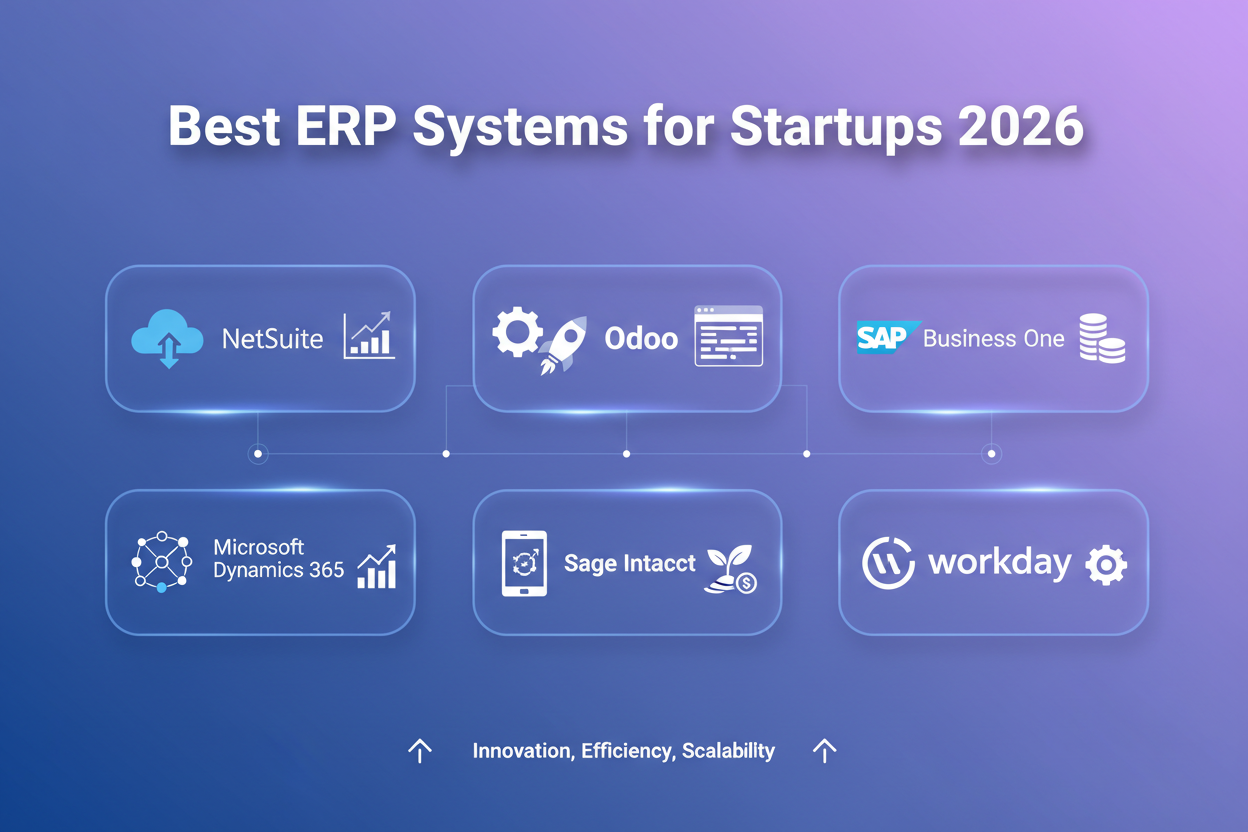
Today’s ERP platforms are cloud-first, AI-enabled, and designed to connect finance, operations, supply chain, HR, and customer data into one unified ecosystem. The goal is simple: reduce complexity while improving control and insight. Below is a detailed comparison of the best ERP software for startups 2026, outlining where each fits best and what makes them stand out.
1. Microsoft Dynamics 365
Microsoft Dynamics 365 remains one of the most widely adopted ERP solutions in 2026. Its modular structure allows businesses to start with Business Central for small and mid-sized operations, then expand into Dynamics 365 Finance and Supply Chain Management as they scale.
What makes Dynamics 365 particularly attractive is its deep integration with Microsoft 365, Teams, Azure, and Power BI. For organizations already using Outlook, Excel, or SharePoint daily, the transition feels natural rather than disruptive.
Key strengths include:
- Seamless ecosystem integration: Native compatibility with Microsoft tools allows teams to work within familiar environments while accessing real-time ERP data.
- AI-driven automation: Copilot assists with invoice reconciliation, demand forecasting, and budget variance analysis, reducing manual workloads.
- Flexible deployment options: Primarily SaaS-based, with hybrid capabilities via Azure for organizations requiring more control.
- Scalable modular structure: Companies can activate additional modules as their operational complexity grows.
Dynamics 365 is ideal for CIOs and finance leaders seeking a balanced mix of scalability, analytics, and user familiarity.
2. Oracle Fusion Cloud ERP
Best for: Large enterprises with complex global operations and regulatory demands
Oracle Fusion Cloud ERP continues to lead in enterprise-grade financial management. It is particularly strong in multinational environments where compliance, tax complexity, and multi-entity reporting are critical. Oracle’s vertically integrated technology stack, from Oracle Cloud Infrastructure to its autonomous database, ensures strong performance and data security.
Key Advantages Include:
- Advanced global financial management: Robust support for multi-country tax rules, currency management, and consolidated reporting.
- Embedded AI capabilities: Predictive planning, risk scoring, and anomaly detection help reduce financial exposure.
- Strong procurement and supply chain automation: Designed to manage complex workflows across global networks.
- Pure SaaS architecture: Automatic updates reduce maintenance burden and ensure access to the latest innovations.
Oracle Fusion Cloud ERP is best suited for CFOs managing multinational organizations that require precision, compliance, and scalability.
3. SAP S/4HANA
Best for: Global manufacturers and enterprises with highly complex supply chains
SAP S/4HANA remains one of the most powerful ERP systems for product-centric organizations. Built on an in-memory database, it enables real-time analytics and large-scale transaction processing. In 2026, SAP’s focus on cloud transformation and embedded AI has modernized its traditional enterprise reputation.
Core strengths include:
- Deep manufacturing and logistics functionality: Advanced materials planning, production scheduling, and global supply chain visibility.
- Real-time processing: In-memory computing provides instant financial and operational insights.
- Industry-specific solutions: Strong adoption in automotive, pharmaceuticals, utilities, and consumer goods sectors.
- AI-enhanced planning tools: Predictive MRP and intelligent demand forecasting improve efficiency.
SAP S/4HANA is ideal for large enterprises that require structured, proven processes at global scale.
4. Oracle NetSuite
Best for: Fast-growing mid-market companies and global startups
Oracle NetSuite was one of the first cloud-native ERP systems, and it continues to dominate the mid-market. It combines financial management, CRM, inventory, and eCommerce into one integrated platform. NetSuite is especially popular among high-growth businesses that need international scalability without building complex infrastructure.
Notable strengths include:
- Unified cloud platform: ERP, CRM, and commerce capabilities operate within one environment.
- Real-time dashboards: Executives gain instant access to KPIs and financial performance.
- Scalable global functionality: Multi-currency and multi-subsidiary support.
- Automated financial close and reporting: AI-driven forecasting reduces month-end stress.
NetSuite is a strong choice for founders and finance leaders transitioning from basic accounting systems to a fully integrated ERP environment.

5. Workday
Best for: Service-driven and workforce-centric organizations
Workday excels in environments where people are the primary asset. Originally known for Human Capital Management (HCM), it has expanded significantly into financial management and analytics.
The system offers a modern, intuitive user interface and advanced workforce planning capabilities.
Key Highlights Include:
- Integrated HR and finance platform: Tight alignment between workforce data and financial planning.
- AI-powered analytics: Forecasting, anomaly detection, and performance insights.
- Strong subscription billing and service management tools: Particularly valuable for SaaS and consulting firms.
- Cloud-only deployment: Ensures consistent upgrades and reduced infrastructure management.
Workday is particularly effective for higher education, healthcare, consulting, and other service-heavy industries.
6. Infor CloudSuite
Best for: Industry-specific operations in manufacturing, healthcare, and retail
Infor CloudSuite differentiates itself through industry specialization. Rather than offering one-size-fits-all software, it provides tailored editions for specific verticals.
Advantages Include:
- Pre-configured industry workflows: Faster implementation due to built-in best practices.
- AWS-powered cloud deployment: Reliable infrastructure and scalability.
- Embedded analytics and AI tools: Production scheduling and inventory optimization.
- Modern user interface: Designed to improve adoption and reduce training time.
Infor is a solid choice for businesses seeking vertical-specific ERP functionality without excessive customization.
7. Epicor Kinetic
Best for: Discrete manufacturers and industrial operations
Epicor Kinetic focuses on complex production environments such as make-to-order and engineer-to-order manufacturing.
Key capabilities include:
- Advanced production planning: Tools for managing shop-floor operations and materials planning.
- Manufacturing execution system integration: Real-time shop-floor visibility.
- Predictive maintenance tools: Reduce downtime and equipment failures.
- Flexible deployment models: Cloud, hybrid, or on-premise options.
Epicor is particularly effective for industrial businesses modernizing legacy manufacturing systems.
8. Acumatica Cloud ERP
Best for: Mid-market businesses seeking flexibility and cost efficiency
Acumatica has gained popularity due to its unique consumption-based pricing model, which allows unlimited users without per-seat licensing costs.
Strengths include:
- Open API architecture: Enables seamless integration with third-party tools.
- Strong financial and distribution management: Suitable for growing operational complexity.
- Lower total cost of ownership: Competitive alternative to tier-one ERP vendors.
- Frequent feature updates: Active product development roadmap.
Acumatica is ideal for companies that need enterprise-grade capabilities without enterprise-level licensing costs.
9. Odoo
Best for: Startups and small to mid-sized businesses seeking modular flexibility
Odoo offers an open-source foundation with a vast ecosystem of modules covering CRM, accounting, inventory, and manufacturing.
Why Businesses Choose Odoo:
- Modular architecture: Companies can start small and activate additional apps as needed.
- Affordable entry point: Attractive pricing and affordable ERP for small startups compared to traditional ERP systems.
- Extensive customization options: Ideal for businesses with development capabilities.
- Active community and partner network: Broad ecosystem support.
Odoo works well for startups and tech-savvy companies that value flexibility and cost control.
How to Choose Best ERP Software for Startups 2026
There is no universal “best” ERP system. The right choice depends on your organization’s size, industry, budget, and long-term growth strategy. When evaluating ERP systems, consider:
- The complexity of your operations and supply chain
- Integration requirements with existing tools
- Scalability for future expansion
- AI and automation capabilities
- Total cost of ownership/startup ERP implementation cost
- Deployment preferences (cloud, hybrid, or on-premise)
In 2026, ERP success is defined by alignment. The best system is not necessarily the one with the most features, it is the one that supports your strategy, adapts to your growth, and provides the visibility you need to make confident decisions.
| ERP System | Best For / Ideal Fit | Deployment | Key Strengths |
| Microsoft Dynamics 365 | Mid-sized to enterprise orgs tied to Microsoft tools | Cloud + Hybrid (Azure) | Seamless Microsoft integration, strong analytics, AI-assisted automation |
| Oracle Fusion Cloud ERP | Large global enterprises & complex financial operations | Pure SaaS | Enterprise financial controls, predictive AI, global regulatory support |
| SAP S/4HANA | Large manufacturers & companies with complex supply chains | Cloud + Hybrid | Real-time processing, deep manufacturing & logistics, embedded AI |
| Oracle NetSuite | Fast-growing mid-market companies & global startups | SaaS | Unified cloud suite (ERP + CRM + commerce), scalable international architecture |
| Workday | Service-driven and people-centric organizations | SaaS | Best-in-class HR + finance, modern UI, AI planning & analytics |
| Infor CloudSuite | Industry-specific verticals (manufacturing, healthcare, retail) | Cloud (AWS) | Pre-configured industry workflows, embedded AI, user-friendly |
| Epicor Kinetic | Discrete manufacturers & industrial operations | Cloud + Hybrid + On-Prem | Advanced shop-floor tools, MES integration, predictive maintenance |
| Acumatica Cloud ERP | Mid-market companies seeking flexibility & lower cost | Cloud | Consumption-based pricing, open APIs, strong financial/distribution tools |
| Odoo | Startups / SMBs seeking modular, open-source flexibility | Cloud or Self-Hosted | Modular apps, cost-effective entry, easy customization, active ecosystem |
Conclusion: The Future of ERP in 2026 and Beyond
ERP systems are no longer just back-office tools. In 2026 and beyond, they are becoming intelligent business platforms that drive strategy, speed, and smarter decision-making. The landscape is shifting toward systems that are more adaptive, connected, and user-friendly.
Several trends are shaping the future of ERP:
- AI and Machine Learning: Modern ERP platforms now use AI for demand forecasting, inventory optimization, predictive analytics, and anomaly detection. This reduces guesswork and helps leaders act faster with confidence.
- Composable Architecture: Businesses want flexibility. Composable ERP systems allow teams to adjust workflows and processes without long development cycles.
- Cloud-first Deployment: Cloud ERP for early-stage companies continues to dominate due to its scalability, remote access, lower infrastructure costs, and automatic updates.
- Real-time Visibility: Leaders expect live dashboards that show performance across procurement, inventory, finance, and fulfillment.
- Simplified Integrations: Strong ERP platforms connect easily with 3PLs, e-commerce platforms, EDI systems, and financial tools.
Making the Right ERP Decision
Choosing an ERP system requires careful evaluation of your company’s size, industry, growth plans, and operational complexity. There is no one-size-fits-all solution.
Consider this guidance:
- If you prioritize speed and operational agility: Look for modern, flexible platforms that can deploy quickly and evolve with you.
- If you run a large, multinational operation: Choose a system with deep financial controls and global compliance capabilities.
- If you want a fully cloud-native, all-in-one solution: Focus on mature SaaS ERP platforms.
- If your company relies heavily on Microsoft tools: An ecosystem-aligned ERP will simplify adoption.
- If you operate in manufacturing or niche industries: Industry-specific ERP solutions may provide stronger built-in processes.
- If budget and mid-market value matter most: Seek platforms that balance functionality with predictable pricing.
As you evaluate your options, think beyond today’s needs. Ask where your business will be in three to five years. The right ERP system should support growth, improve agility, and give you better visibility, not lock you into rigid processes. Choose a platform that adapts to your strategy, scales with your ambition, and empowers your team to make smarter decisions every day.








Post Comment