Employer of Record for Startups Explained (Hire Globally in 2026)


Startups move fast. Teams grow rapidly, new markets emerge, and the need for specialized talent often extends beyond national borders. But hiring internationally is not as simple as posting a job online. Every country has its own set of rules governing employment contracts, taxes, payroll, and employee benefits. Setting up a legal entity in each location can take months, something most early-stage startups simply cannot afford.
This is why many founders are turning to Employer of Record (EOR) for startup services. An EOR allows a company to hire employees in another country without establishing a local entity. The EOR becomes the legal employer on paper, handling contracts, payroll, taxes, and compliance with local labor laws. Meanwhile, the startup retains full control over the employee’s role, responsibilities, and performance.
In 2026, the demand for EOR solutions continues to grow as remote work and distributed teams become the norm. For startups trying to scale quickly, EOR services provide a practical way to access global talent while avoiding complex administrative barriers. This guide explains how Employer of Record services work and compares the top EOR providers for startups in 2026, helping founders and HR leaders choose the right partner for international hiring.
Best EOR Services for Startups 2026
The best Employer of Record (EOR) services for startups in 2026 help companies hire international talent quickly without setting up legal entities in multiple countries. These platforms manage payroll, taxes, employment contracts, benefits, and compliance with local labor laws while startups focus on product development and growth.
What is an Employer of Record (EOR) for Startups?
Hiring talent across borders can be exciting for startups, but it often comes with complicated legal and operational challenges. Every country has its own employment laws, payroll rules, tax requirements, and benefits regulations. For a growing startup, setting up a legal entity in each new market can be expensive, slow, and difficult to manage. This is where an Employer of Record (EOR) becomes valuable.
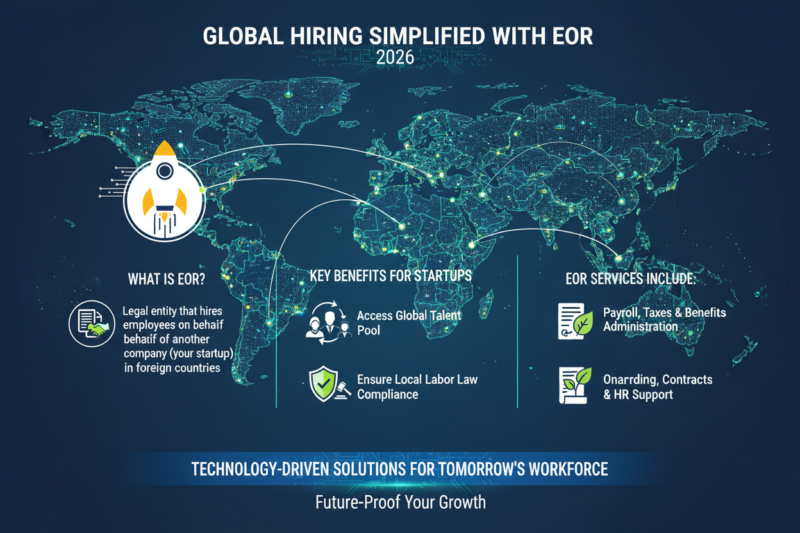
An Employer of Record is a third-party organization that legally employs workers on behalf of your company in countries where you do not have a registered business entity. While your startup manages the employee’s daily responsibilities, projects, and performance, the EOR handles all the legal and administrative employment tasks.
In simple terms, the EOR acts as the official employer on paper, allowing your company to hire international talent quickly and compliantly without establishing a local subsidiary. This model helps startups expand globally while avoiding the long timelines and high legal costs associated with setting up foreign entities. Instead of spending months navigating unfamiliar labor laws, businesses can focus on building their teams and growing their products.
Key Services Provided by an Employer of Record for Startups
A reliable EOR provider manages the complex employment processes required for global hiring. These services allow startups to build international teams while staying compliant with local laws. Common EOR services include:

- Global Payroll Management
An EOR processes employee salaries in local currencies while managing tax withholdings, social security contributions, and statutory filings. This ensures accurate payroll while reducing the risk of penalties caused by compliance errors. - Locally Compliant Employment Contracts
Employment agreements are prepared according to each country’s labor laws. These contracts cover wages, benefits, working hours, termination terms, confidentiality clauses, and intellectual property protection. - Benefits Administration
EOR providers manage mandatory benefits such as healthcare coverage, pensions, paid leave, and insurance programs. They also help companies offer competitive packages that match local employment standards. - Employee Onboarding and Offboarding
From collecting employment documentation to managing compliant exit procedures, the EOR handles the entire employee lifecycle while ensuring all legal requirements are met. - Immigration and Work Permit Support
When international employees require visas or work permits, EOR providers help manage the documentation and regulatory processes involved. - HR Support and Compliance Guidance
Many EOR providers offer HR expertise to help companies handle employee relations, workplace policies, and local employment practices in different countries.
Why Startups Use Employer of Record Services
For startups looking to expand internationally, speed and compliance are often the biggest challenges. An Employer of Record for startups simplifies this process by handling the complex employment infrastructure required for global hiring. Using an EOR offers several advantages:
- Faster Global Hiring
Companies can hire employees in new countries within days instead of waiting months to establish a legal entity. - Reduced Legal Risk
The EOR manages local labor laws, tax compliance, worker classification, and employment regulations, lowering the risk of fines or legal disputes. - Simplified Payroll Operations
Payroll processing, tax filings, and statutory contributions are handled in one system across multiple countries. - Cost-Efficient Expansion
Startups avoid the high cost of registering entities, hiring legal advisors, and managing international compliance on their own. - Access to Global Talent
EOR services allow companies to hire the best candidates regardless of location, helping startups build diverse and distributed teams.
In today’s remote-first work environment, global hiring is becoming a core part of startup growth strategies. Employer of Record services provide the legal structure and operational support that make international hiring simple, compliant, and scalable. By partnering with the right EOR provider, startups can expand into new markets faster while staying focused on innovation and long-term growth.
How Startups Hire International Employees Legally
For many startups, hiring the right people can determine whether the business grows or struggles to scale. Sometimes the best candidate for a role is not located in the same city or even the same country. Understanding how startups hire international employees legally is essential when building a global team.
Hiring international employees allows startups to access global talent, but it also requires careful planning to ensure the process is legal and compliant. When done correctly, international hiring can strengthen a startup’s capabilities and open the door to long-term growth opportunities.
Why Startups Hire International Talent
One of the biggest advantages of international hiring is access to a much wider talent pool. Limiting recruitment to a single location can make it harder to find specialists in fields such as software development, marketing, design, or data analysis. By expanding the search globally, startups increase their chances of finding highly skilled professionals who can contribute immediately.

International hiring can also provide financial flexibility. In some regions, the cost of living is lower than in major startup hubs, which can lead to more competitive salary expectations. This does not mean compromising on talent. Instead, it allows startups to hire skilled professionals while managing their operating budgets more efficiently.
Another benefit is diversity. Teams made up of people from different cultures and backgrounds often bring fresh ideas and new ways of solving problems. These perspectives can help companies design products and services that work well for a global audience.
Challenges Startups Should Prepare For
While the advantages are clear, hiring internationally also brings challenges. Understanding how startups hire international employees legally becomes essential when navigating different employment systems across countries. Each nation has its own labor laws, tax regulations, benefits requirements, and employment protections. Companies must follow these rules carefully to avoid fines, disputes, or compliance issues.
Payroll can also become more complex when employees are located in multiple countries. Employers must handle currency conversions, local taxes, and statutory benefits, all of which vary by region. Communication and collaboration may require adjustment as well. Time zone differences and language barriers can affect workflows if teams do not have clear communication practices in place.
The Legal Ways Startups Hire International Employees
There are two common ways startups legally hire employees in other countries. The first option is to establish a legal entity in the country where the employee lives. This approach gives the company full control but can take months to complete and involves significant legal and administrative costs.
The second option is to work with an Employer of Record (EOR). An EOR acts as the legal employer on paper while the startup manages the employee’s daily work. For many startups, using an EOR is the faster and more practical way to hire international employees legally. It allows companies to build global teams quickly while reducing compliance risks and administrative complexity.
Global Hiring Solution for Startups
Many startup founders assume they cannot compete with large corporations when it comes to hiring top talent. Big companies may offer impressive campuses, large HR departments, and extensive benefits packages. However, today’s global workforce is changing, and startups have more opportunities than ever to attract highly skilled professionals from around the world.
With the right global hiring solution for startups, even small teams can access international talent and build competitive, distributed workforces. In reality, startups do not need massive infrastructure to build a strong global team. What they need is a clear vision, a flexible work environment, and the right hiring structure.
What Global Talent Really Looks For
While mission and innovation attract many professionals to startups, experienced candidates also look for stability and professionalism. Talented employees want to know that their contracts follow local laws, their benefits are competitive in their country, and their salaries will be paid accurately and on time.

For startups expanding internationally, meeting these expectations can be difficult without the right support. Managing employment contracts, payroll, benefits, and tax compliance across multiple countries requires knowledge of local regulations and administrative systems.
How EOR and AOR Solutions Help Startups Compete
This is where Employer of Record (EOR) and Agent of Record (AOR) solutions become valuable for growing companies. An Employer of Record (EOR) allows startups to hire full-time employees in countries where they do not have a legal entity. The EOR becomes the legal employer on paper and handles payroll, benefits, employment contracts, tax filings, and compliance with local labor laws. Meanwhile, the startup manages the employee’s daily responsibilities and performance.
For freelancers and contractors, an Agent of Record (AOR) provides similar support. An AOR helps create compliant contractor agreements, manages invoicing, and ensures reliable payments across borders. This structure allows startups to work with global contractors while maintaining proper worker classification and compliance.
Focus on Vision While the Infrastructure Is Handled
By using solutions like EOR and AOR services, startups can implement a reliable global hiring solution for startups and offer the same professional employment experience that large companies provide without building a full internal HR department.
This approach allows founders to focus on what truly attracts talent: a strong mission, meaningful work, and the opportunity to grow alongside an innovative company. With the right global hiring infrastructure in place, startups can compete for top talent anywhere in the world and build distributed teams that support long-term growth.
EOR vs. Contractor Startup Hiring
Expanding your startup internationally opens the door to a much larger pool of talent. You are no longer limited to hiring within your local market, which makes it easier to find specialists who can help your company grow. However, global hiring also introduces new responsibilities.
Understanding EOR vs. contractor startup hiring becomes important as businesses evaluate different ways to bring international talent on board. Companies must understand local employment laws, tax rules, and compliance requirements before bringing people onto their teams.
For startups hiring across borders, two common approaches are using an Employer of Record (EOR) or working with independent contractors. Both options allow companies to hire internationally without setting up a legal entity in another country. Still, they operate very differently when it comes to legal obligations, payroll management, and how closely workers are integrated into your team. Understanding the differences between these two hiring models can help startups avoid compliance risks and choose the best approach for their workforce strategy.
What Is an Employer of Record (EOR)?
As mentioned earlier, an Employer of Record (EOR) is a service provider that legally employs workers on behalf of your company in countries where you do not have a registered business entity. While the EOR becomes the official employer on paper, your startup continues to manage the employee’s daily work, responsibilities, and performance.
The EOR handles administrative and legal responsibilities such as payroll processing, tax filings, employment contracts, statutory benefits, and compliance with local labor laws. This arrangement helps businesses avoid common risks like worker misclassification, tax penalties, or violations of local employment regulations.
For startups entering new markets, an EOR can significantly speed up hiring. Instead of spending months establishing a legal entity in another country, companies can onboard employees quickly and remain compliant from day one. It also makes it easier to scale teams up or down as business needs change.
What Is an Independent Contractor?
An independent contractor is a self-employed professional who works with a company under a service agreement for a specific project or period of time. Contractors operate their own businesses and are responsible for managing their taxes, benefits, and work arrangements.
Companies often hire contractors when they need specialized expertise or temporary support. Because contractors work independently, businesses avoid many of the long-term commitments associated with full-time employment, such as payroll taxes, employee benefits, or employment protections.
This model offers flexibility and can be cost-effective for short-term work. However, companies must be careful about worker classification rules, which vary by country. Misclassifying someone who should legally be an employee as a contractor can lead to fines, back taxes, and legal complications.
Choosing the Right Hiring Model
Both hiring models have their place in a startup’s global workforce strategy. The best EOR services for startups 2026 are usually the better option for long-term roles that require close collaboration with your team and compliance with local employment laws. Contractors, on the other hand, work well for project-based assignments or specialized tasks that do not require permanent employment.
Many startups adopt a hybrid approach, combining EOR employees for core roles with contractors for short-term projects. Following a startup remote hiring compliance guide can help founders understand the legal requirements involved in global hiring and avoid common compliance mistakes. This balance allows companies to scale globally while maintaining flexibility and compliance. By choosing the right hiring structure from the beginning, startups can expand internationally with confidence and build teams that support sustainable growth.
| Feature | Employer of Record (EOR) | Independent Contractor |
| Legal Employer | The EOR is the legal employer on behalf of your company | The contractor is self-employed |
| Payroll & Taxes | Managed by the EOR, including payroll, tax withholding, and social contributions | Contractors handle their own taxes and invoicing |
| Employment Compliance | Fully handled by the EOR according to local labor laws | Company must ensure proper classification to avoid legal risks |
| Benefits | Statutory benefits such as healthcare, paid leave, and pensions are provided | Contractors manage their own benefits |
| Level of Control | Company manages daily tasks and performance, within employment structure | Contractors work independently and manage their own processes |
| Intellectual Property Ownership | Typically protected through employment contracts | Must be clearly defined in contractor agreements |
| Cost Structure | Higher due to service fees, payroll taxes, and benefits | Usually lower upfront cost for project-based work |
| Best Use Case | Long-term roles, full-time employees, and building global teams | Short-term projects, specialized expertise, or temporary work |
| Risk of Misclassification | Very low, as the EOR ensures proper employment classification | Higher risk if contractor roles resemble employee responsibilities |
| Scalability | Easy to scale international teams quickly and compliantly | Requires managing multiple contracts and payments |
Conclusion: Choosing the Right EOR for Your Startup
There is no universal best Employer of Record for every startup. The right choice depends on your company’s hiring goals, the countries where you plan to recruit, how quickly you need to onboard talent, and the level of compliance support you require.
Instead of relying on generic rankings, focus on providers that align with your hiring strategy and growth plans. Compare the total cost, service scope, and regional expertise, not just the headline price. A strong EOR partner should make international hiring simpler while giving your team the confidence that payroll, taxes, and employment compliance are handled correctly.
For many early-stage startups, an EOR has become the easiest way to begin hiring internationally. It removes the need to set up legal entities and allows companies to access global talent quickly. However, as your business grows, it is important to reassess your hiring structure. In some markets, transitioning to a local entity or hybrid model may eventually make more sense.
In other words, think of an EOR as a launchpad for global hiring rather than a permanent solution. The most successful founders regularly evaluate their workforce strategy and adapt it as their company expands. An EOR simplifies the first step of global expansion by removing the operational barriers that often slow companies down. With the right partner, you can build international teams faster, enter new markets confidently, and focus your time on growing your business.
What to Do Next
If you are planning to hire internationally, here are a few practical steps to move forward:
- Define Your Hiring Priorities: Identify which countries you plan to hire in and the types of roles you need to fill.
- Shortlist Two or Three EOR Providers: Focus on companies with strong coverage in your target regions and transparent pricing models.
- Compare Total Costs: Look beyond service fees and review payroll taxes, benefits administration, and compliance support.
- Book Product Demos: Ask questions about onboarding timelines, support quality, and platform usability.
- Evaluate Long-term Flexibility: Choose a provider that allows you to scale teams easily or transition to other hiring structures if needed.
Global hiring no longer needs to be complicated or slow. With the right Employer of Record partner, startups can access talent worldwide, manage employment compliance smoothly, and grow their teams with confidence. If you are exploring global hiring solutions, booking a demo with a trusted EOR provider is often the best way to see how the model fits your startup’s needs and expansion plans.
FAQs
Is using an Employer of Record worth it for small startups?
Yes, in many cases it is. For startups hiring one or two employees in another country, an EOR is often more practical than setting up a local entity. Creating a legal entity can take months and involve significant legal and administrative costs. An EOR allows startups to hire quickly while staying compliant with local employment laws, payroll requirements, and tax regulations.
Can a startup switch from an EOR to its own local entity later?
Yes, many companies begin with an EOR model and transition to their own setup once they establish a long-term presence in a country. This process usually involves transferring employment contracts, payroll responsibilities, and benefits from the EOR to the new company. A good EOR provider can support this transition and help ensure employees move smoothly without disruptions.
Does an Employer of Record replace the company’s HR team?
No. An EOR does not replace your internal HR team. Instead, it handles the legal and administrative side of employment, such as payroll processing, employment contracts, tax compliance, and statutory benefits. Your internal HR team still manages recruitment, performance management, company culture, and employee development.
How long does it take to hire an employee through an EOR?
In most cases, onboarding an employee through an EOR can take anywhere from a few days to two weeks, depending on the country and documentation requirements. Many modern EOR platforms use digital systems that allow contracts to be signed electronically and payroll to be set up quickly, which helps startups hire international talent much faster than establishing a local entity.
Can an EOR help convert contractors into full-time employees?
Yes. Many startups begin by working with contractors and later decide to hire them as full-time employees. An EOR can help make this transition easier by creating a compliant employment contract, moving payments from contractor invoices to payroll, and ensuring taxes, benefits, and local employment rules are handled correctly.










Post Comment