Operational Debt And Its Impact On Early-stage Technical Organizations
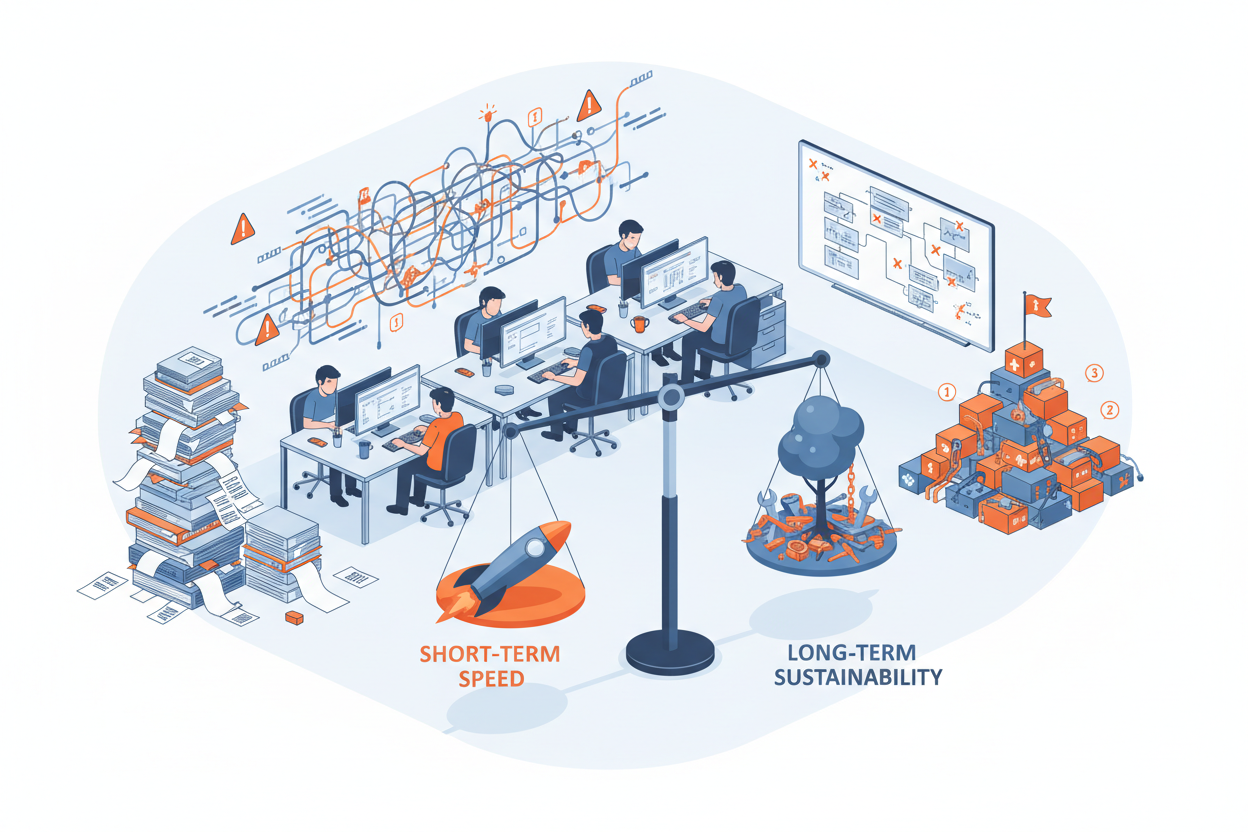
In early-stage technical organizations, speed often feels like survival. Teams rush to ship features, close deals, and satisfy investors, making decisions that solve today’s problems as quickly as possible. This is where operational debt quietly begins to build.
Most people are familiar with technical debt, a term introduced by software pioneer Ward Cunningham in 1992 to describe the long-term cost of taking shortcuts in code. Just like financial debt, these shortcuts save time upfront but demand repayment later through refactoring, fixes, and maintenance. When left unchecked, technical debt slows development, raises costs, and limits a team’s ability to adapt.
But technical debt is only one part of a broader picture. Early-stage organizations also accumulate operational debt across product decisions, workflows, documentation, staffing, pricing models, and even communication practices. These hidden compromises reduce clarity, strain teams, and make growth harder over time. Understanding operational debt early helps founders and technical leaders balance short-term progress with long-term resilience, ensuring today’s speed does not become tomorrow’s obstacle.
This article explores how operational debt forms in early-stage technical organizations, how it shows up across engineering, product, and business operations, and why it often goes unnoticed until it starts limiting growth. It also outlines practical ways leaders can recognize early warning signs and make smarter trade-offs that support sustainable scale instead of short-term fixes.
What Operational Debt Looks Like
You usually do not need an audit to spot operational debt. You feel it. It shows up in daily friction that everyone accepts as normal, even though it is quietly exhausting the business.
Operational debt often looks like this:
- One person holding all the knowledge and heading toward burnout
- Inventory surprises that appear only when it is already too late
- Frequent shipping mistakes and missed deliveries
- Messy handoffs between teams that rely on guesswork, not shared data
- SOPs that live in someone’s head or scattered, outdated documents
- Leaders working late nights to fix the same problems again and again
At its core, operational debt is the result of quick process fixes that were never meant to last. Teams end up firefighting in loops, founders make every decision, tools multiply without clarity, and communication spreads across too many channels.
The cost is real. Delays become routine, teams burn out, customers lose trust, and productivity drops. Over time, the weight of these temporary workarounds slows everything down, drains morale, and makes growth far harder than it needs to be.
Why Is Operational Debt So Dangerous and Where Does It Come From?
Operational debt is dangerous precisely because it rarely announces itself. It builds quietly, masked by momentum, until a single disruption exposes how fragile things really are. One sick team member can stall entire workflows. One surge in demand can overwhelm systems and frustrate customers. One small system change can trigger failures across departments. The damage is rarely isolated. It ripples.

The real risk is time. Operational debt moves slowly, borrowing from the future one short-term decision at a time. You don’t realize how much you owe until the business hits a wall and agility disappears.
Most founders do not create operational debt by choice. It creeps in while they are moving fast, solving immediate problems, and working with limited resources. ‘We will fix it later’ decisions linger. Hiring happens without onboarding or documentation. Teams scale before systems are ready. Old processes are copied from past jobs, even when they no longer fit.
Over time, these shortcuts drain productivity, exhaust teams, and cost companies up to 20–30% of revenue annually. Operational debt does not just slow you down. Left unmanaged, it quietly limits your ability to adapt, compete, and grow.
Navigating the Four Types of Debt in Operational Teams
When early-stage technical organizations talk about debt, the conversation usually stops at code. Technical debt gets the spotlight, and for good reason. But operational debt runs much deeper. To grow without friction, teams must recognize four interconnected forms of debt that quietly shape execution, morale, and scalability: technical, product, marketing, and pricing debt.
1. Technical Debt: The Cost of Speed Without Structure
Technical debt forms when teams prioritize quick delivery over sound architecture, documentation, and testing. In the early days, this often feels unavoidable. Shipping fast can win customers and buy time. Over time, however, shortcuts turn into bottlenecks. Bug fixes take longer, new features become risky to deploy, and developers spend more time maintaining old systems than building new ones. Managing technical debt is not about perfection. It is about knowing when speed is worth the trade and when stability must catch up.
2. Product Debt: When More Features Create Less Value
Product debt builds when features are added reactively rather than intentionally. Each new option may solve a short-term request, but together they can clutter workflows, confuse users, and complicate maintenance. The result is a product that does too much but does little well. Reducing product debt means simplifying. Strong product teams regularly reassess what truly serves users, remove friction, and protect clarity as the product evolves.
3. Marketing Debt: Misalignment Between Promise and Reality
Marketing debt appears when messaging drifts away from what the product can actually deliver. This often happens when marketing moves faster than product development or when updates are not clearly communicated internally. The impact is subtle but serious. Customers feel misled, trust erodes, and sales teams struggle to manage expectations. Close alignment between product, marketing, and operations keeps messaging honest and sustainable.
4. Pricing Debt: Complexity That Slows Growth
Pricing debt grows when pricing models evolve without structure. Custom deals, legacy contracts, and inconsistent terms may help close early sales, but they complicate billing, forecasting, and scaling later. Over time, teams spend more energy managing exceptions than serving customers. Addressing pricing debt requires standardization, transparency, and the courage to revisit outdated agreements.
Together, these debts shape how smoothly an organization operates. Recognizing them early allows leaders to make smarter trade-offs, protect team momentum, and build systems that support growth instead of resisting it.
Comparison of Operational Debt Types in Early-Stage Technical Organizations
| Debt Type | What It Is | How It Commonly Forms | Early Warning Signs | Impact on Teams & Growth | How to Address It |
| Technical Debt | Long-term cost of shortcuts in code, architecture, or testing | Tight deadlines, quick fixes, poor documentation, outdated tools | Slower releases, recurring bugs, fragile systems, developer frustration | Reduced agility, higher maintenance effort, delayed innovation | Allocate time for refactoring, improve documentation, set quality standards, balance speed with sustainability |
| Product Debt | Complexity caused by unfocused or excessive features | Feature creep, reactive roadmap decisions, limited user validation | Confused users, bloated interfaces, difficult maintenance | Lower user satisfaction, higher support load, slower iteration | Simplify features, prioritize core value, use regular user feedback, conduct usability reviews |
| Marketing Debt | Gap between product reality and external messaging | Poor product-marketing alignment, rushed campaigns, outdated positioning | Customer confusion, trust issues, sales friction | Weakened brand credibility, longer sales cycles, churn | Align teams closely, update messaging often, base claims on real capabilities |
| Pricing Debt | Inconsistent or outdated pricing structures that complicate operations | Custom deals, legacy contracts, unplanned pricing changes | Billing confusion, margin erosion, contract disputes | Slower scaling, operational overhead, forecasting issues | Standardize pricing, revisit contracts, simplify tiers, improve transparency |
Getting Ahead of Operational Debt Before It Slows You Down
Operational debt is not a failure of leadership. It is a natural byproduct of building and growing under pressure. Early-stage technical organizations move fast because they have to. But when short-term decisions stack up without review, momentum slowly turns into drag. The goal is not to eliminate operational debt entirely. It is to manage it intentionally before it limits growth.
Tackling operational debt requires a broad, connected approach rather than isolated fixes. Teams that address one area while ignoring others often find the same problems resurfacing in new forms.

A strong foundation usually includes the following practices:
- Regular Audits Across Functions
Periodic reviews of code quality, product complexity, marketing alignment, and pricing structures help teams spot friction early. These audits are not about blame. They are about visibility. What once worked may no longer serve the business as it scales.
- Cross-Functional Collaboration
Operational debt thrives in silos. When engineering, product, marketing, and sales operate independently, misalignment becomes inevitable. Shared planning sessions and clear ownership help teams move in the same direction and reduce downstream rework.
- Customer Feedback as a Decision Filter
Listening to customers consistently prevents product and marketing debt from compounding. Feedback reveals where complexity has crept in, where promises feel unclear, and where pricing or value no longer matches expectations.
- Clear and Proactive Communication
Whether it is pricing changes, feature updates, or roadmap shifts, transparency matters. Clear communication builds trust internally and externally and makes transitions far smoother.
Each type of operational debt presents challenges, but it also offers opportunities. Cleaning up technical debt can unlock faster development. Reducing product debt can sharpen focus and usability. Fixing marketing debt restores credibility. Addressing pricing debt simplifies scale.
For early-stage teams, the real risk is not having debt. It is ignoring it for too long.
Conclusion: Seeing Operational Debt for What It Really Is
Operational debt is quiet until it isn’t. It hides beneath the surface while teams push forward, only revealing itself when a launch misses the mark, a key employee burns out, or growth starts to feel heavier instead of energizing. The real work begins when leaders choose to look below the iceberg, question familiar ways of working, and realign decisions with long-term health rather than short-term relief.

The goal is not perfection. It is awareness, intention, and course correction. Especially in early-stage technical organizations, where resources are tight and every decision touches the runway, proactive management of operational debt becomes a leadership skill, not an operational chore.
That clarity allows founders to act before small compromises turn into structural barriers.
As you move forward, a few lessons stand out:
- Treat operational systems like an MVP. They must be valuable and viable, not perfect.
- Accept short-term inefficiency without letting it become permanent.
- Avoid expanding faster than your foundations can support.
- Hire carefully. Every role matters more than the headcount.
- Align people to the stage you are in, not the stage you aspire to.
- Position talent thoughtfully and recognize contributions openly.
Operational debt does not mean failure. Left unmanaged, it limits momentum. Managed well, it becomes a tool for learning, adaptation, and resilience. If you start paying attention now, you don’t just protect your business. You give it the space to grow with confidence, clarity, and purpose.














Post Comment